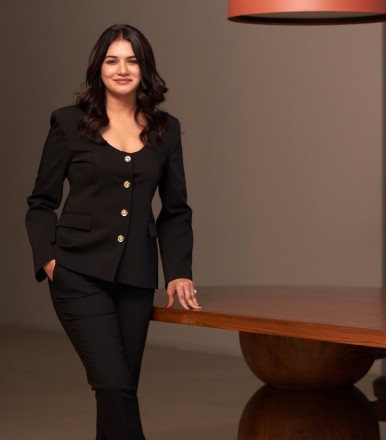
There are artists who choose theatre. And then some artists are claimed by it
Aditya Rawal belongs to the latter. His creative beginnings were shaped by school corridors buzzing with debates, sports grounds that demanded discipline, and stages that quietly waited for him to find his voice. Before he knew it, storytelling had become not just an escape, but a destination. Today, he writes, acts, and co-directs with a conviction rooted in lived experience, of a footballer who gave up a time-bound passion to pursue a timeless craft, "I want to be a storyteller for life", and of a storyteller who believes stories choose how they want to be told.
What follows is an intimate exploration of his craft, part interview, part reflection, where the story grows, and acts reveal the instinctive, ever-evolving journey of a modern theatre mind.
Q. What was the first moment you realised theatre wasn't just a medium you enjoyed, but a space you wanted to build, shape, and direct?
Aditya smiles at the memory, almost as if he's walking back into an old school corridor. He talks about a childhood rich with encouragement, parents who were living and loving the art, and a school that fueled his everyday creative impulse. Between sports, debates, and plays, he found himself constantly performing. He even played professional football until 21, training six hours a day. Writing began merely as a break, but soon became the place he felt most like himself.
"I realised I couldn't pursue both professionally," he says. "Sports are age-limited. Writing felt like a lifetime calling. Something in me leaned towards storytelling, and I chose it. Now, looking back, I'm happy I did."
Q. As someone deeply rooted in theatre, what does 'live storytelling' mean to you beyond the literal presence of an audience?
"It is the literal presence of the audience that changes everything," Aditya corrects. For him, theatre is a commitment, performers offer time and effort, audiences offer attention and presence and money. In that exchange of energy, in that sacred contract, something magical is born.
"The story is alive because the people in the room are alive with it."
Q. When you write a play, what comes first, character, conflict, or the visual world?
For Aditya Rawal, the seed of an idea is unpredictable. A line you overhear, a person you notice, an incident on the street, anything can begin the chain reaction. That first spark leads to questions: Where is this character? What if this happens? What grows from here?
"Answering those 'what if' questions gives birth to the world," he explains. He has written across formats, plays, films, prose, and poetry, and believes the story decides its own entry point. "It is instinctive. The story chooses where it wants to start."
Q. Every director has a signature process. What's the one non-negotiable element in your rehearsal room?
Though he doesn't direct full-time, Aditya is often in rehearsal spaces for the parts he writes. For him, the foundation is simple: respect and discipline, these are something he cannot compromise on.
"Life is too short to work with abusive people, verbally, emotionally, or physically. Basic decency is non-negotiable. Come on time, come prepared, and do the work. That matters to me."
Q. What is the hardest kind of scene to direct: silence, chaos, or confrontation? Why?
"It depends," he says thoughtfully. "Sometimes writing a scene is easy but directing it is hard, and sometimes it's the reverse. Any scene can look easy, but doing any scene well is difficult."
Q. As an actor yourself, how does being on stage inform the way you guide performers when you're directing?
"Being an actor makes me a better writer, and being a writer makes me a better actor."
He explains that when writing, he immediately knows whether it's achievable from a performer's point of view as he is also one. And as a writer, he understands the emotional subtext beneath lines and staging while he acts. "One feeds the other," he says. "They help each other grow."
Q. In an era of shrinking digital attention spans, what can modern theatre still do better than any other medium?
Aditya Rawal believes theatre will only grow more relevant, especially in an AI-driven world where the line between real and fabricated blurs.
"Theatre has lasted 5000 years and will last long after us. When we begin distrusting what we see on screens, live performance becomes even more sacred. Audience and performer meet in the same moment, in the same space, committing their time and selves to the story. That connection will outlast any technological leap."
Q. If you could reinterpret a classic play, not remake, but reimagine, which would it be and why?
He chooses not a classic play, but a cinematic gem: Satyajit Ray's Aranya Din Ratri (Days and Nights in the Forest).
"It feels even more relevant today," he says. "City people escape into the forest to leave behind the chaos of urban life, only to bring that chaos with them and turn the village into a city. I think it would adapt beautifully, on stage or on screen."
Q. When moving between stage and screen, how do you translate theatre's breath, its pauses, stillness, and exaggeration into the microscopic lens of cinema?
He compares theatre to a wide shot: your whole body exposed, your voice carrying to the last row, your emotions enlarged. Cinema, however, demands concentration, the same emotion distilled into a close-up, sometimes just the eyes or a shift in body language.
"Both are different, both beautiful. The intention remains the same — the expression adjusts."
Q. If your artistic journey were a metaphor from a play, what scene are you currently in?
In the beginning, when the character sort of finds himself, there is this incident, some realisation that motivates him to act. And when he starts taking action, that is the beginning of the second act. "With a play's structure in mind, beginning, middle, end, I think I'm at the beginning of the second act for now, I can say I am really, really excited about it," Aditya says.
Check out Hello Fitness Magazine. There is never a wrong time to go on a fitness quest. Contact us and allow us to assist you in leading a better lifestyle. Follow us on Instagram. We share the best Health & Fitness related Articles for information based on healthy eating, health and fitness recommendations, health problems and their solutions, human body fitness, and much more.