


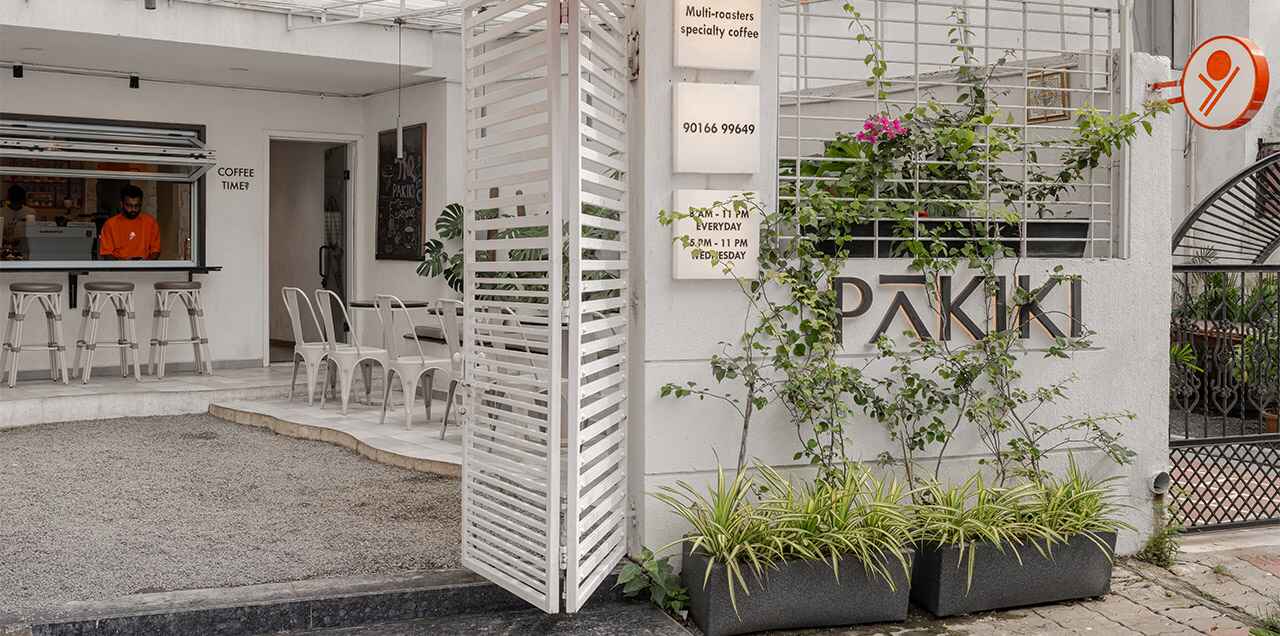
It's 6:30 in the morning, and the city is only just beginning to stir. But inside Pakiki, the day has already found its rhythm. Black coffees move steadily across the counter. A few regulars occupy the same tables they claim most mornings, and conversations unfold without hurry.
There is no visible rush, only familiarity. Staff greet people by name and remember their orders without writing them down, as though repetition has quietly turned them into ritual.
Near the counter, Sayam Bothra adjusts a cup before it leaves the pass, watching the room more than the clock. What exists here did not come together overnight. It has taken close to a decade of deliberate choices, calculated risks, and a willingness to learn by doing. As he puts it, much of the journey has been about "figuring out and controlling only the controllables."
That instinct, to focus on what can be shaped rather than what cannot, defined him long before Pakiki opened its doors. To understand the café, you have to begin with the environment that shaped its founder, and the clarity with which he decided, years ago, that business would not be an option but a direction.
Sayam Bothra: The Visionary
Why business?
For Sayam Bothra, the question almost answers itself. "I am a Marwadi Gujarati, living in Surat," he says, with matter-of-fact clarity.
In his world, enterprise was not a rebellion against convention but an extension of it. By fourteen, he had already decided he would do something on his own. Not to inherit and operate an existing enterprise, but to build.
At eighteen, after reading a few books that nudged him toward long-term thinking, he wrote down a line that would linger for years: he wanted to open ten to fifteen cafés. "It was a part of my manifestation," he recalls.
The note sat quietly in the background. There were phases when he forgot about it, phases when he was simply working. But the industry never really left him. By his late twenties, he had already spent close to eight years in hospitality.
Five of those years unfolded in Melbourne, where coffee is less a beverage and more a language. He arrived for a short trip and stayed on, drawn to a culture that treated cafés as living spaces rather than transactional counters. There, he learned about standards, sourcing, and what it means to serve a cup that reflects care, even when nobody is seeing it.
Returning to Surat happened with intent. "I have been born and brought up here," he says, a reminder that he understood the city's appetite and pace despite its competitive café scene.
What he brought back from Melbourne was not a template but a sensibility. "There's a way in which people like to consume coffee," he reflects. Standards mattered, and so did engagement. The idea that small gestures shape how a space is experienced stayed with him. From that thinking, Pakiki began to take form: a café built for the curious.
Pakiki and the Café Economics
When asked why the name Pakiki and what it means, Sayam slips easily into what he calls his "marketing and branding guy" mode. "I had shortlisted a few hundred names. Every time something sounded interesting, I wrote it down."
For him, a name was never just a label. Fonts, colours, the way a word feels when spoken, all of it had to align. None of the early options carried the feeling he was looking for. Then he stumbled upon a New Zealand tourism line that mentioned "the land of Pakiki."
The word lingered. "I like the sound of that word; I like how it looks when you write it down." When he discovered it meant 'inquisitive' or 'curious,' the choice felt natural. "People cannot say this word sadly," he says. "It automatically brings a smile."
But a name does not build a café. "A café cannot survive on aesthetic memory alone. There are two things: café, the place, and then there is the product-centric mindset." Pakiki tries to balance both. The space is designed for familiarity and engagement, but the coffee remains central. He pushes conversations about multiple roasters and different beans, insisting on standards even if no one is seeing them.
Beyond the cup, there are F1 communities, music nights, festival celebrations, and workshops. "You can have this coffee in any café," he says, "but where you want to sit down to have it actually matters."
Funding, Discipline, and the Cost of Growth
Running a café is not as romantic as it often appears. Sayam has learned this firsthand. "A café is not about revenue. It is about the cash coming into your business every single day," he says. Margins are thin, and disruptions are real. A few slow days can tilt the month. Expansion, then, cannot be impulsive. It has to be structured.
Skin in the Game
In the early days, there were no external backers. "Whatever I had left over from Australia, I was the first one to put skin in the game," he says. The decision was deliberate.
If he was asking others to believe in the idea, he had to signal belief first. It was his way of showing that there was no second option. This was going to work.
Capital Strategy
Once he gained confidence from the first two outlets, he began exploring larger capital conversations. The first café did not demand institutional funding. The scale was manageable, and execution was quick. They built it in 45 to 60 days.
But growth changes the equation. With plans for multiple outlets, he now prefers raising capital for three or four cafés together rather than one at a time. Scale, in his mind, requires team structure, operational clarity, and financial discipline before momentum.
Learning the Discipline
For Sayam, growth is less about speed and more about structure. He is candid about his own evolution. "In terms of financial literacy, I am very young in the business," he admits.
His father anchors the numbers. "The strategies are mine, and the accounting and discipline are his." Their conversations are daily. Expansion plans are weighed against structure as he worries about scale outrunning systems.
"I don't want to look back five years later, see success on the surface, and discover a flaw in our foundation." Avoiding that possibility has become part of his ambition.
There's One Way Up
For Sayam, the future is not about opening doors faster. It is about building foundations strong enough to hold them. He wants more outlets, a stronger team, and systems that can withstand pressure without losing the culture that defines Pakiki.
"My vision is not to sit and relax if one thing is working," he says. Yet the emphasis remains on standards and care, on ensuring that growth does not dilute intent. In a business shaped by daily margins and daily moods, his journey so far suggests something quieter than bravado: expand with conviction, but build with discipline.
Check out Hello Fitness Magazine. There is never a wrong time to go on a fitness quest. Contact us and allow us to assist you in leading a better lifestyle. Follow us on Instagram. We share the best Health & Fitness related Articles for information based on healthy eating, health and fitness recommendations, health problems and their solutions, human body fitness, and much more.